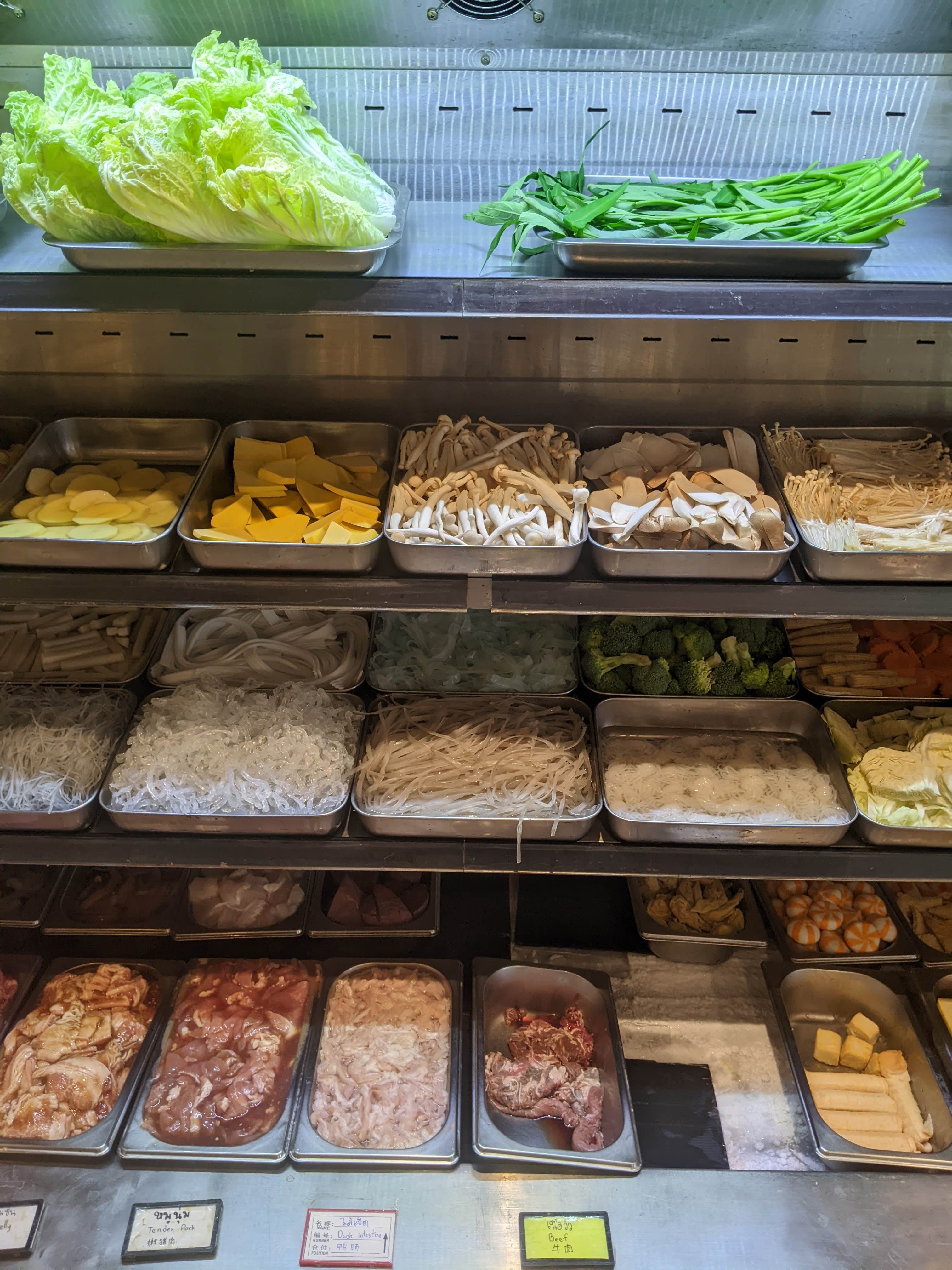
30-second clean mala order
- Pick beef, fish, chicken, or eggs.
- Add mushrooms, pumpkin, carrot, sprouts, greens, and cilantro.
- Skip sausages, fish balls, fake crab, mystery tofu, sweet noodles, and bright processed items.
- Ask for no MSG, no seasoning powder, no sugar, and no oil.
- Get sauce separate or no sauce.
- Choose true clear broth if it exists. If not, eat the cooked solids and skip broth.
- Say no plastic bag before they start packing.
Mala and malatang shops can look chaotic: rows of meats, mushrooms, vegetables, noodles, tofu products, fish balls, sausages, sauces, and broth options. That chaos is exactly why most people use the format badly.
But if you are a health-conscious foreigner in Thailand, mala is one of the rare restaurant formats where you can still make the important decisions yourself. You can build a bowl from real food, keep the sauce separate, avoid sweet broth, and refuse hot plastic before the staff starts packing.
For Healthy Farang readers, mala is not about chasing the spiciest soup. It is a way to get real food, fewer mystery additives, and less hot-plastic exposure while still eating out in Chiang Mai, Thailand, and across Asia.
The clean-food move is not "order mala." The move is to use mala like a system: real ingredients first, processed items out, broth treated like a decision, and no plastic before packing.
Why mala works when most restaurants fail
The usual restaurant problem is invisibility. You do not see the oil. You do not see the sugar. You do not know what powder or sauce went into the wok. With mala, at least the first decision is visible: what goes into your bowl.
The food is usually boiled, not fried. The meal is fast. The format is common around Asia. And in Thailand it can be good value: Jason's bowl at Tak Tak Mala in Nimman was 179 THB, while Vince said similar bowls in Korea can run around 15 USD.
That does not make every mala bowl clean. It means the format gives you leverage. Once you know these moves, mala stops being "junk with peppers" and becomes one of the few restaurant formats where you can eat like someone who cares about future blood work.
Build the bowl from real food
Protein first
- Beef
- Fish
- Chicken
- Eggs
Then volume
- Mushrooms
- Pumpkin
- Carrot
- Sprouts
- Greens
- Cilantro
Carbs only if wanted
- Small rice noodle portion
- Pumpkin
- Other plain starches
Your win is a bowl of food you can recognize, boiled simply, with as little sugar, oil, sauce, and plastic as possible. Do not overcomplicate it. Protein first, vegetables second, carbs only if you actually want them.
What destroys a clean mala bowl
The trap is treating the entire ingredient case as permission to grab everything. That is how a good format turns into a heavy, salty, sweet, processed bowl that only looks healthy because a few greens are floating in it.
Processed add-ins
Sausages, fish balls, fake crab, mystery tofu, bright processed items, and sweet noodles are what turn a clean mala bowl into the same junk you were trying to avoid.
Sweet or cloudy broth
The broth can carry sugar, oil, seasoning powder, MSG, milk, or sauce. Treat it as the highest-leverage choice, not background liquid.
Sauce and hot plastic
A clean bowl can get messy fast at the sauce station or takeaway counter. Sauce separate and no plastic bag are not details. They are the move.
Choose the cleanest broth at a mala restaurant
Broth is where the clean-food question gets serious. These are not exact menu names from Tak Tak Mala. They are practical categories that help you think clearly about broth choices in any mala shop.
Best: true clear broth
If a real clear broth exists, start here. Still ask whether sugar, MSG, or seasoning powder is added.
Good if confirmed: mild / custom clear-style broth
This is the practical target when the shop can make the bowl mild, simple, and less seasoned. Confirm what actually goes into it.
Flavor tradeoff: shabu / soy-style broth
This can be comfortable and familiar, but it may be soy-like and somewhat sweet. Use it for flavor, not as the cleanest default.
Fun but highest-risk: spicy / mala broth
This is where the heat and numbing Sichuan peppercorn flavor live. It is also where sauce, seasoning powder, sugar, oil, and additive risk can climb.
Skip: unclear broth or hot plastic
If the broth is unclear, sweet, oily, heavily seasoned, or has to go into hot plastic, leave it. The cooked solids are still the main event.
The rule is simple: do not let broth ruin the bowl. If you can confirm a true clear broth, use it. If you cannot, eat the cooked solids and skip broth. You still got the part you came for: a bowl of whole food you chose yourself.
The counter script
You do not need to turn lunch into an interrogation. You need a few clean defaults. These romanized phrases are working field language, not perfect formal Thai, so confirm them locally when possible:
| Ask for | Say |
|---|---|
| No MSG | mai sai phong churot |
| No seasoning powder | mai sai phong prung rot |
| No sugar | mai sai namtan |
| No oil | mai sai namman |
| No sauce | mai sai nam jim |
| No soup / broth | mai ao nam sup |
| No plastic bag | mai ao tung plastic |
The highest-value ask is no MSG, no seasoning powder, no sugar, no oil, sauce separate or no sauce, and no plastic bag. If the staff can repeat that cleanly, the restaurant becomes much more useful.
If you live in Chiang Mai, mala is only one part of the clean-food map. Start with the Clean Food hub, then read the deeper Clean Eating in Chiang Mai guide.
The Tak Tak Mala field test
This guide came from lunch at Tak Tak Mala next to Zuzalu Library in Nimman, Chiang Mai. Vince, a Korean friend who has eaten malatang in China and Korea for years, walked Jason through the format and the broth choices.
Jason's bowl was 179 THB. Vince said a similar bowl in Korea can be about 15 USD, while China is often cheaper. That price gap matters because it makes mala in Thailand a realistic clean-food fallback, not just a novelty.
Tak Tak Mala is a field example, not a fully verified clean restaurant. The cooking vessel, exact broth ingredients, MSG policy, seasoning powder policy, oil use, and repeatability still need confirmation. The recommendation here is the ordering method, not a blanket claim about the venue.
The takeaway rule: say no plastic first
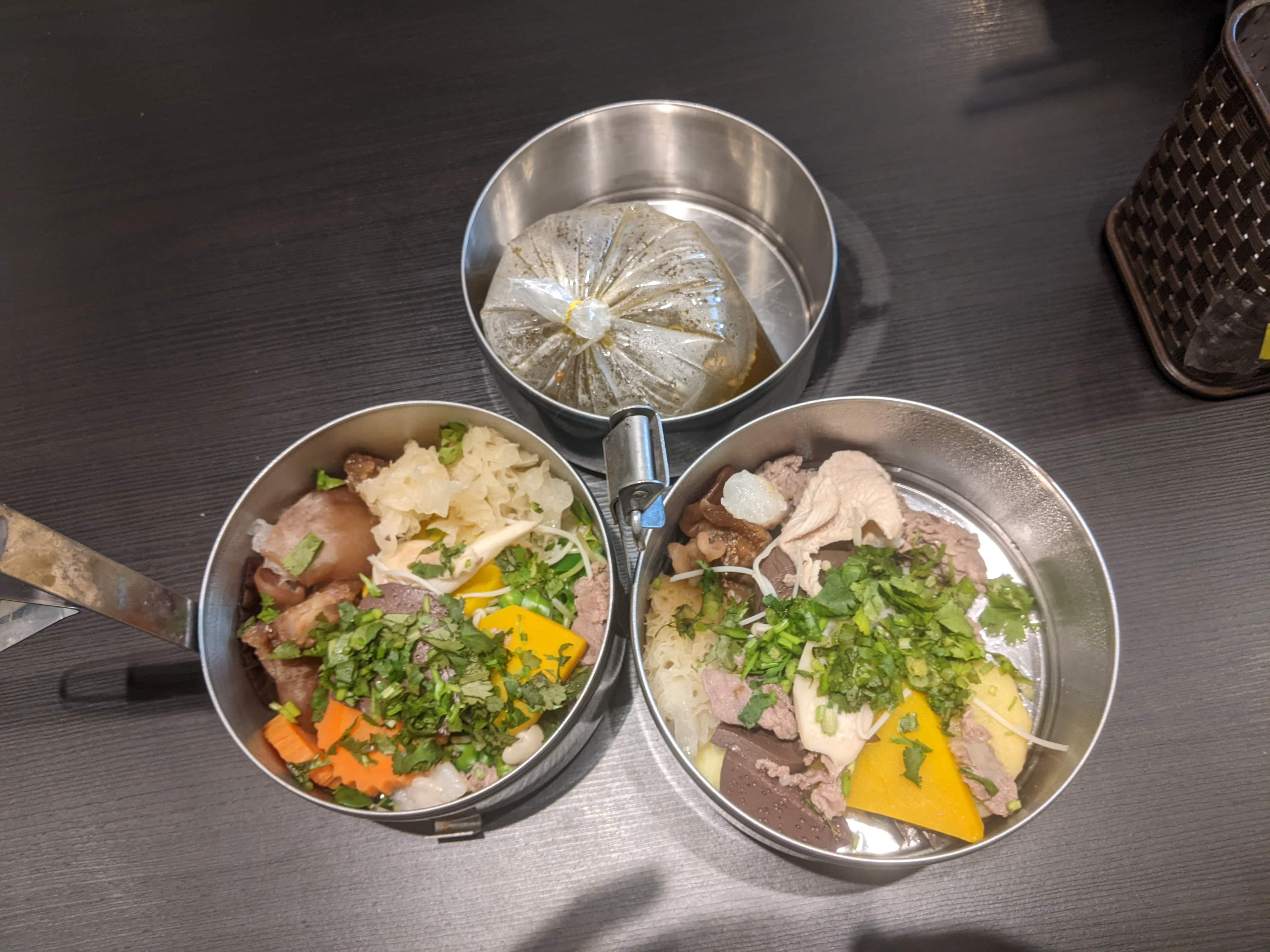
Jason brought a stainless steel stackable container. The staff put the cooked food into it, which was a win. But the soup went into a separate plastic bag inside the container.
If you remember one takeaway rule, make it this: hot soup in a thin plastic bag is the opposite of clean eating. If the broth has to go into plastic, treat it as a condiment you leave behind, not the main event.
Say it before anyone starts packing: No plastic bag. Food only in this container. No soup if soup needs plastic.
Clean mala order you can copy in Chiang Mai
- Choose beef, fish, chicken, eggs, mushrooms, pumpkin, carrot, sprouts, greens, and cilantro.
- Skip sausages, fish balls, fake crab, mystery tofu, sweet noodles, and bright processed items.
- Ask for no MSG, no seasoning powder, no sugar, no oil, and sauce separate or no sauce.
- Choose true clear broth if available. If not, eat the cooked solids and skip broth.
- If taking away, bring stainless and say no plastic bag before they start packing.
- Eat the bowl slowly and pay attention to energy, digestion, and sleep over the next few hours.
FAQ
Can you eat healthy at a mala restaurant in Thailand?
Yes, if you use the format correctly. Choose whole-food ingredients, keep the broth simple, avoid processed add-ins, and control sauce and takeaway packaging. The method is the recommendation, not any single restaurant by default.
What should I avoid in malatang if I care about MSG and sugar?
Avoid the processed tray, sweet noodles, mystery tofu products, heavy sauces, and unclear broth bases. Ask for no MSG, no seasoning powder, no sugar, and sauce separate or no sauce.
What is the cleanest broth at a mala restaurant?
A true clear broth is the best target if the shop has one and can confirm what is in it. If the broth is unclear, sweet, oily, heavily seasoned, or packed hot into plastic, skip it and eat the cooked solids.
How do I ask for no MSG, no sugar, and no oil in Thai?
Use the phrase table above as working field language: mai sai phong churot for no MSG, mai sai namtan for no sugar, and mai sai namman for no oil. Confirm phrasing locally when possible.
Found a mala shop, shabu spot, salad bar, or Thai kitchen that can handle clean-food requests well? Send it through the clean-food source form so Healthy Farang can check it.